Thursday, September 16, 2010

Peg Communities? How about we start respecting each other and our choices?


Bell and Bauman have different views about online communities and how they impact society. This is not just a debate between both of them, but between millions of online users and their counterparts. My stand here is, as mentioned in DTC 475, that technology is subjective. We will always have those who believe that technology is improving our lives and we will always have those who will believe that technology is taking down the essence of personal interaction and communication. My question here is, why worry about fighting against each other and why can’t we all accept that everyone is different? What works for some does not work for others, so why can’t we all start respecting each other and our choices?

I, personally, love online communities or should I say, that I love the way technology allows me to communicate with other people whenever I want. For some, it could be true that “virtual communities lack the durability and intensity of RL communities” but I keep insisting that this argument is subjective (Bell 255). For me, online communities are just like phones, they help me stay connected with whomever I want and whenever I want. My own “online community” does not harm the durability and intensity of my RL community, if fact, it enhances my RL and I’ll tell you why…

I met my husband on an online community of music lovers two years ago and we got married this summer. My relationship with my partner was not less durable or less intense as that of any other couple that met at a coffee shop or somewhere else. In fact, I could even argue that my relationship with my partner and the distance between us (I live in Washington, he lives in Venezuela) forced us to push even harder and made us look beyond the body and into the soul.  Our relationship (although sustained via online interfaces) made my RL more real, but what made it a relationship was not the online communities, but what each of us decided to put in, such as patience, love, trust, respect and understanding.

All of the online communities to whom my partner and I belong to did not withdraw us from our RL taking us into a virtual word, they did not acted as “coat peg” where we could “hang our interests or obsessions, our enthusiasms or worries,” we just used them to communicate as you would use a phone or the post office (Bell 257).  

So like I said in the beginning, technology is subjective, what works for me enhancing my real life, might be harming or might be withdrawing someone from the “real life” and into the virtual life. So how about we all stop looking into other’s lives and instead learn to look at ourselves, like Bell concluded in his writing, jut “stop worrying!” and “get over it!” let people make their own choices (Bell 261).

Works Cited:
Bell, David. "Webs as Pegs." The Cybercultures Reader. David Bell and Barbara M Kennedy. New York: Routledge, 2000. Print.

Part Two: Choosing 3 Online Sites

To compare similar websites and their representation strategies I would like to compare MySpace and Facebook because there is a big battle between both of them on who attracts and keeps more members active (or at least I believe) and I personally see that MySpace is starting to resemble Facebook in a lot of ways, so I would like to see them “face to face”. For the third website, I would like to use Deezer, just because I see Deezer as a loner who does his own thing, his own way. But I’ll need to think further about using it, because both MySpace and Facebook are just social sites, while Deezer is a social site where you meet people but not based on profiles but on music tastes.

Thursday, September 9, 2010

Reanalyzing Yahoo!


Burnett and Marshal published their book in 2003, which maybe one of the reasons why the authors and view Yahoo! a little bit different than how I view Yahoo!

Since Burnett and Marshal published their book, I believe that the internet was changed the way we look at things or at least that the people have helped changed the way the information is presented to us. I personally believe, we (internet users) have changed the way we like to look at stuff and most of us will prefer something that grabs our attention with images, videos or music over something that presents the information in a simple yet not exciting way.
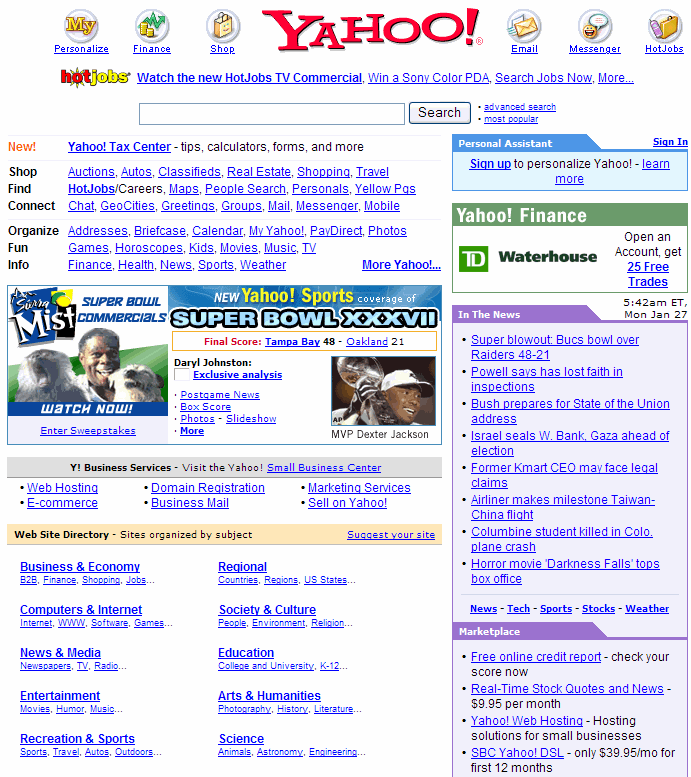
Yahoo! Main Page in 2003

After reading the work by Burnett and Marshal, I can say that the way they looked at Yahoo! back in 2003, is different than how I view Yahoo! now in 2010. The authors divided their critique into three different categories and two stages.  During the first stage, color and contextual dimensions were evaluated. Yahoo! back in 2003 had the Yahoo! symbol right on the center of the page in bright red color with a very distinct font, while the rest of the text on the page was regular black and no full sentences were observed on display of the page. In 2010, however, the symbol of Yahoo! remains written in a funky way but it is not in the center of the page and is not red, but purple. Now I would ask myself why the change in color and in location would matter, but the way I look at it is, that back in 2003, Yahoo! was battling against other pages in search of recognition, and if you somehow landed on the page, the makers of Yahoo! wanted to make sure that you knew that you were using their services. In 2010, Yahoo! has no need to battle with other companies just over a name, the makers are now focusing on having their users know, not that they are on Yahoo! but that Yahoo! provides you more results than other search machines (You see, the Yahoo! symbol was moved to the right of the page and was replaced by a search bar).

In one of my earlier paragraphs I had mentioned that people are changing the way internet is presented to us. The reason why I say this is because we now live in a word where visual appeal will have an impact on how you view a web site. Back in 2003, Yahoo! was pretty boring with less than a few images and with a boring Times New Roman lettering. Burner and Marshal stated in their work that Yahoo! makers probably excluded as many images from the main page, because images were heavy and as a result they slowed down the loading of pages. But of course, the internet was slower back then. In 2010, visual images, videos and sounds have taken over many pages including Yahoo! and information for the most part is now presented in very interesting and appealing ways.

Yahoo! Main Page in 2010

During the second stage of Burnett and Marshal’s critique, they analyzed the links showed on the main page, the user’s ability to personalize, interactivity between the user and other users or between the users and the site and the interplay of different media forms. Now on this second category, I would say that there wasn’t been much of a change, Yahoo! still promotes other pages though the use of links, and the user with an account can personalize what information is presented to him/her and how it is presented. The main observable change in the page is of course the addition of more and more categories and the change in their order as people began requesting and using other services. I say this, because back in 2003, Yahoo! had six main categories from which to choose from, while now the Yahoo! user has about 18 categories shown. Quite a change!

On a final note, Burnett and Marshal stated in their work that “the more financially endowed the site, the more likely that… standard techniques of interaction are operating” and I do agree with that statement to one level (Burnett and Marshal). It is true that in 2009, Yahoo! partnered with Microsoft and therefore the organization increased its financial stability, giving the site the opportunity to keep up all of the services offered, but I personally believe, as stated before that the user is the one who draws on for the different changes on a web site and not only the funds available for the development (the funds are important too, but with no request, no need to develop, right?). What the user prefers to use, how it is presented and how it works in part depends on the user who either supports or not supports a certain feature of the site. Yahoo! and other websites are up and working thanks to the user interaction and they have to adapt to what the user prefers and how they prefer it, otherwise the user will simply go to another page that offers what he/she wants to see and use. In the end, the user has a voice...


Works Consulted:

Burnett, Robert, and P. David Marshal. Web Theory: an introduction. New York: Routledge, 2003. 95-101. eBook.

Goldman, David. "Yahoo-Microsoft Search Deal Gets Final OK." CNN. 18 Feb 2010, Web. September 9, 2010. http://money.cnn.com/2010/02/18/technology/yahoo_microsoft/

Thursday, September 2, 2010

Digital Divide: the have’s, have not’s and the in-betweens


The term “Digital Divide” us often defined as an ever-growing gap between the haves and the have-not’s of technology, but this is not it. The reality is that not everything is simply black or white; we also have all the grays and shades in-between. For example, there have been many projects around the world of organizations who believe that giving technology (computers) will solve the gap, but the reality is that the technology by itself does not solve the issue(Warschauer). If you do not know how to use that computer, or if you do not have the resources to properly keep the computer working and the internet access available, it really will not make a difference. Mark Warschauer, author of Reconceptualizing the Digital Divide, believes that the term has been wrongfully defined. He thinks that the Digital Divide is not just about having or not having access to technology and that other issues of “content, language, education, literacy, or community and social resources” are often left out of the equation (Warschauer). But what if you access to information does not depend technology but on your willingness to learn? You can give a computer to someone, but you can’t make them click. After all, technology is not just about having or not having a devise, but about using the device as an interface (physical channel of communication) between people and information. The digital divide is not about access to technology, but about access to information and communication. 

It kind of works like a business, you can’t just give someone a coffee shop and expect them to compete against the Starbucks down the corner. You also need to ensure that they know how to properly prepare the coffee, muffins and sandwiches, that they know how to maintain and operate all of the equipment or at least where to call for help, you need to make sure that all of the information in the coffee shop is written in a way that allows all of the workers to understand it, you will need to teach the workers how to declare prices and how to reorder supplies.  But best of all, you also need to ensure that whomever will take on the coffee shop is willing to strive and make a change for their own good and that they will put it all together, up and running.

Solving the Digital Divide is not just about giving computers and internet access to people, it is also about informing people and gathering resources; it is about ensuring that they know how it works and how they can use it for their own benefit. To me the digital divide is the combination of barriers (personal, physical, economic, political, societal, ect), that limit a person’s ability to access technologies of information to communicate and interact with others.


Works Cited
Warschauer, Mark. "Reconceptualizing the Digital Divide." First Monday 7.7 (2002): n. pag. Web. 31 Aug 2010. <http://firstmonday.org/htbin/cgiwrap/bin/ojs/index.php/fm/article/view/967/888>.

Thursday, August 26, 2010

Ageless Rhetoric


After reading the first chapter of Contemporary Perspectives of Rhetoric, I can only come to the conclusion that there is not only one, but many, definitions for the term “rhetoric”. The authors of the book have been nice enough to give us an introduction to the big dilemma surrounding its meaning and I say a big dilemma because, since there are many definitions for the term, many people that have studied and taught anything dealing with how we communicate with each other are therefore rhetoric students and teachers without really acknowledging their use of rhetoric.  According to the authors, however, there might be a common definition for the term among those who have dedicated a portion of their lives to study rhetoric. For the authors, rhetoric is “an art and a discipline that facilitates our understanding of the nature and function of symbols in our lives” (Foss et al. 1). But for those of us, who will probably never study the matter, the term “rhetoric” could mean something as simple as a channel of communication through the use of symbols. Since anything we use to communicate with each other is rhetoric, whenever we use, a word or a picture, a letter or an email, a call or an IM or anything else that helps us express our feelings and needs we are using rhetoric.
Now, when we take rhetoric and the digital world we empower ourselves with some very powerful tools. To me, digital cultures are groups of people who use technology to enhance their communication. Some examples of the digital cultures that I personally use take place through my phone and my pc. With my phone I am able to call, text or IM with many people. With my pc, I am able join formal and informal digital cultures. I do personal and professional emailing and messaging and I have been a part of MySpace, Facebook, Hi5, Deezer, Qpasa and other social sites at one point or another.  Anything I type, paste or embed is rhetoric. Anything on my profile, whether is it my pictures, my background, my videos, my music and even my username are symbols that empower me with the possibility of communicating with others becoming not just a representation of what they are, but also a representation of what I am, what I want to be or whom I was at one time, what I feel, what I want or even what I don’t want. Anything that I post or don’t post online helps represent me with the rest of the individuals in that digital culture and if it helps me communicate with others is rhetoric.

Works Cited
Foss, Sonja K., Karen A. Foss, and Robert Trapp. Contemporary Perspectives on Rhetoric. Third Edition. Waveland Press, 1-15. PDF.